what is the relationship between erotic pleasure and sacred beauty?
...a theological exploration pt. i


for centuries, christian belief systems have strived laboriously to separate our understanding of the body from that of the spirit, therefore separating our understanding of pleasure from that of the divine. however, there are innumerable mystical experiences within this earthly realm that transcend language and require bodily participation for true comprehension, giving way to the beauty of unexplainable things. perhaps our perception of bodily pleasure has been skewed by religions’ attempt to separate the divine from these embodied experiences, which begs the question: what is the relationship between erotic pleasure and sacred beauty?
the religious grappling between body and soul often results in a vast disconnect within our human selves. according to St. Teresa of Avila, this is an early indicator of what hinders our connection to the divine because, “what could be worse than not being at home in our own house? what hope do we have of finding rest outside of ourselves if we cannot be at ease within?” (Interior Castle, 62). the necessity for humans to be at home and embodied within themselves is directly linked to a person’s capacity for pleasure or, in other words, their capacity to experience a bodily response towards beauty. when we allow our bodily feelings, including those of the erotic and ecstatic, to inform us in ways our rational minds may fail to do at times, we open ourselves up to a deeper experience of soul/self, which in turn leads to a deeper understanding of true union with the divine.
although language often fails to explain our spiritual and mystical encounters, St. Teresa does her best to explain them anyway and does so through the metaphor of consummating an engagement, which is universally understood to be an erotic experience. this is because bodily desires and experiences are not only inescapable, but informative. they act as a language in and of themselves, with erotic pleasure being to mystical spirituality what an encounter with sacred beauty is to the divine — a bodily experience that transcends our full understanding, turning us further heavenward.

in Elaine Scarry’s book On Beauty and Being Just, she discusses beauty as being “bound up with the immortal, for it prompts a search for a precedent, which in turn prompts a search for a still earlier precedent, and the mind keeps tripping backward until it at last reaches something that has no precedent, which may very well be the immortal . . . what is beautiful is in league with what is true because truth abides in the immortal sphere” (30-32). perhaps this is how “beauty” becomes sacred — by detaching itself from rationale and entering into a realm of mystic wonder, evoking statements regarding “truth” and answering the bodily promptings to bring copies of beauty into being. in other words, sacred beauty inspires the created to become the creator, utilizing us further as one with the likeness of the divine.
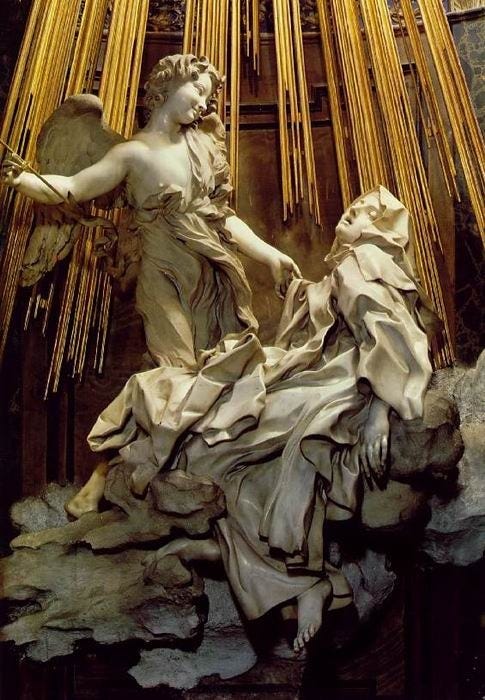
artists like Gian Lorenzo Bernini, the Italian sculptor, painter, and architect, have answered these promptings by creating many works of art inspired by sacred beauty. Bernini does so by turning to sexual imagery to convey moments of mystical transverberation, such as in his famous marble sculpture Ecstasy of Saint Teresa. this work depicts the Carmelite nun swooning in religious ecstasy, a bodily response (with certain critics suggesting an explicitly erotic response), to an encounter St. Teresa herself reports having had with the divine. similar to how St. Teresa details religious ecstasy as being both a spiritual and bodily experience, Bernini’s sculpture becomes a point of contact for its audience between heaven and Earth — between sacred beauty and embodied feeling.
in continuing with the idea of sacred beauty inspiring acts of creation, it is important to bring up the most obvious act of creation: conception. our human desire to procreate could be seen as nothing more than an animalistic instinct, but when viewed through the lens of spirituality becomes an important representation of our own divine nature. despite religious ideology often fragmenting our understanding of bodily pleasure in relation to the divine, we cannot argue with the fact that every person was brought into this world through a literal climax of erotic pleasure. humans take part in this act of creation for many reasons, of course, but one explanation of procreation is that of Elaine Scarry’s, where beautiful things inspire the impulse to bring new things into being. when we consider the human spirit as being sacred and divine, and see how it works in congruence with the human body rather than against it, it becomes obvious how sacred beauty is inextricably linked to erotic pleasure.
the cyclical nature of creature becoming creator induces a powerful union with the divine in our own souls, harkening back to the concept of “exitus-reditus,” a central part of the theological beliefs of both St. Teresa and Thomas Aquinas which declares that all things find their origin from the divine and all things will eventually re-unite with the divine. this concept is suggested in the seventh and final dwelling place of St. Teresa’s metaphor of the interior castle when she reminds us that, “the soul is more amazed every day as she discovers that these divine Persons never leave her anymore. through sublime knowing she clearly sees that they are with her always. she perceives their sacred presence in a radically inner place, inside her own depths” (Interior Castle, 265). once we recognize our souls as being linked to the divine in such an intimate way, where they are no longer seen as separate but are in fact one in the same, we can then recognize that bodily pleasure is not only an avenue towards comprehension of the divine, but a reflection of sacred beauty itself.
with this understanding, Bernini’s Ecstasy of Saint Teresa takes on a whole new meaning where it no longer is insinuating a bodily climax, but is unequivocally speaking to it. ecstatic and erotic pleasure are not hinderances to the soul, but further our ability to connect body and soul to one another and to divine experiences. the relationship between mystical experiences of the body and those of the soul create similar, if not equal, paths to the divine and free such experiences from religious dogma and doctrine, allowing for a much deeper connection to self/Source to be realized in the end.
the relationship that exists between erotic pleasure and sacred beauty in not only interconnected, but mutually supportive of the idea that bodily responses to mystical experiences enhance our connection and understanding of the divine rather than the formerly held notion they inhibit it. when humans feel connected to themselves, or in other words at one/at home within their own bodies and souls, there is wisdom to be found regarding how bodily experiences can inform our religious and spiritual “truths.” the bodily experiences that occur when confronted with sacred beauty fall within the same category of experience that takes place during moments of erotic pleasure – an unexplainable and transcendental urge to unite with the divine in a multitude of ways. when we turn towards these moments with reverence and curiosity, rather than with shame or condemnation, we allow ourselves to experience the fullness of being both human and at one with the divine. when we recognize the divine as dwelling within our souls, which is housed within our bodies, everything experienced in a lifetime – from mundane encounters to pure ecstasy – reaffirms the understanding that sacred beauty and erotic pleasure arouse us further towards the all-encompassing sanctity of the divine and our connection to it.